Pilates in the Second Trimester: Energy, Back and a Growing Bump

For many women the second trimester is the easiest part of pregnancy. The nausea and the extreme tiredness of the first weeks often ease, and the bump is not yet big enough to get in the way. It is also when your body starts to change in ways you notice as you move: your balance feels different, your lower back may complain and some exercises you used to do easily stop feeling right. This article explains what the guidelines say and how I adapt a private Pilates session in these weeks, so that you can decide with a clear head.

Start with your doctor or midwife
The advice from the first trimester still stands. Pilates is suitable for many pregnancies, but not all, and I ask every pregnant client for her doctor's or midwife's agreement before we begin. If you have already been training with me, it is still worth asking at your next check-up whether anything has changed for you.
What the guidelines say
The American College of Obstetricians and Gynecologists recommends about 150 minutes of moderate activity a week in an uncomplicated pregnancy, and modified Pilates appears on its list of suitable activities. It advises avoiding activities with a risk of falling or of contact. An expert review of physical activity and pregnancy outcomes reports links with lower risks of gestational diabetes, pre-eclampsia and preterm birth, and with better mental health.
What changes in the second trimester
Energy. For many women it comes back, and exercise feels good again. Enjoy it, but do not push because you feel well.
A changing centre of gravity. The bump moves your weight forward, so your balance feels different. I take extra care with standing work and always keep something to hold on to nearby.
Lower back and pelvis. The curve of the lower back often increases, and some women feel pressure around the pelvis.
Pulling at the sides of the bump. A sharp pull when you change position quickly is common. Mention it to your doctor or midwife, and we move more slowly.
Softer ligaments. Hormones keep loosening the joints, so I still avoid taking you to the end of your range.
Breathlessness. As the bump grows there is less room for the lungs, so you may get out of breath sooner. We pace the breathing and the effort.
How I adapt a private session
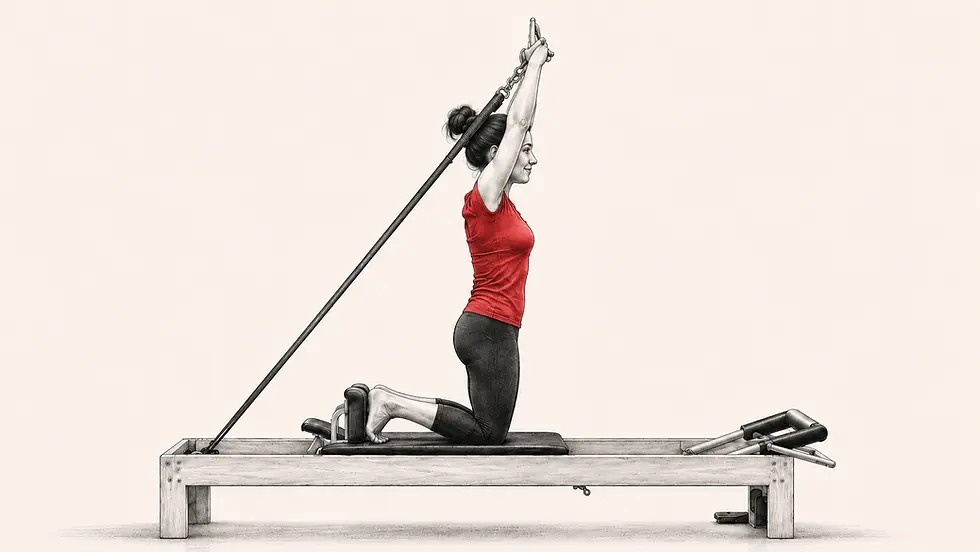
Sessions last 60 minutes. We keep working on breathing, posture and the strength of the legs, back and shoulders, which are the muscles that carry you through the coming months. I avoid exercises that compress or strain the abdomen, and I change the positions as your bump grows, with cushions and wedges so that you can lie comfortably. On the Reformer the springs make the work smooth and controlled, and I adjust the resistance as you change from week to week.
We also work on the pelvic floor. It needs strength, but it also needs to know how to let go, so we link it to the breath and practise both.
Positions and limits I work with
Lying on the front. I avoid it from about 20 weeks, or sooner if your bump gets in the way.
Lying on the back. It is fine in my sessions up to around 26 weeks. After that, only for short periods and always within what feels good.
Lying on the side. It becomes the main position, because it is comfortable and keeps the weight of the bump off your back.
Sitting and standing. Sitting upright on the Reformer or the Wunda Chair and standing work next to a support are very useful in these weeks.
Breathing. I never ask you to hold your breath, because it compresses the abdomen. The focus is on a steady exhale.
Getting up. Roll onto your side and push up with your hands instead of sitting straight up from lying flat.
These are working guidelines, not medical advice. Your doctor or midwife has the final word, and I adapt to how you feel on the day.
Lying on your side: the Cadillac

On the Cadillac, lying on your side, the top leg works against a spring while the bottom leg rests on the mat. You are neither on your back nor on your front, so the position stays comfortable for a long time, and it works the hips and thighs that support the pelvis. The studio has many more apparatus than this one, and they are useful at every stage. I describe them in
Warning signs: stop and call your doctor
Vaginal bleeding.
Regular, painful contractions.
Fluid leaking from the vagina.
Shortness of breath before you start exercising, dizziness, headache or chest pain.
Pain, swelling or redness in the calf.
Muscle weakness that affects your balance.
If you are starting Pilates now
Many women begin Pilates in the second trimester, when they feel well again. We start with a conversation, not with exercise. I ask how far along you are, how you feel, what your doctor or midwife has said about exercise and what you did before you were pregnant. Then we do a gentle first session, and you leave knowing what to do at home between sessions.
A simple way to judge effort is the talk test: you should be able to hold a conversation while you exercise. If you are too breathless to speak in short sentences, ease off. I would rather you finish a session feeling that you could have done more than feeling drained.
If you want to read about the stages before and after this one, see Pilates in the first trimester and Pilates in late pregnancy. For the whole nine months, my article on Reformer Pilates during pregnancy gives the overview.
Frequently asked questions
Is the second trimester a good time to start Pilates?
For many women it is, because nausea and tiredness often ease. In an uncomplicated pregnancy, with your doctor or midwife's agreement, you can start and build up gradually.
Can I keep going to my usual Pilates class?
Some classes can be adapted, but a class is planned for the whole group. In a private session I change the exercises, the positions and the springs for you, and I do it again each week as your body changes.
What if my back hurts more than before?
Back and pelvic discomfort are common as the bump grows. Tell your doctor or midwife, especially if the pain is new or severe, and tell me, so that we adapt the session. Posture and strength work are a useful part of the answer for many women.
Sources
Women who live in Nueva Andalucía will find the studio in Guadalmina Alta easy to reach. If you would like to ask whether Pilates suits your pregnancy, message me on WhatsApp.
About Francisco. Pilates has been Francisco Benítez's profession since 2002. At Authentic Pilates Studio in Guadalmina Alta, Marbella, he gives private sessions of about an hour on the Reformer and the other classical apparatus.


Comments