Prenatal Pilates in Marbella: Cadillac, Wunda Chair, Arm Chair and More

If you are pregnant and looking for a Pilates studio, you probably have questions. Will I be comfortable? Will I have to lie flat on my back? Can I keep working my legs and arms as the bump grows? One thing that helps is the range of equipment a studio has. At Authentic Pilates Studio in Guadalmina Alta, Marbella, I work with the full set of classical apparatus, which lets me change the apparatus as your pregnancy changes.
Why variety matters in pregnancy
Pilates has no jumping and no impact, and every movement is controlled. That already makes it a careful form of exercise. But pregnancy changes what is comfortable from one month to the next. A position that feels fine at ten weeks may not at thirty.
Having several apparatus means that when one position stops working, we move to another and the session carries on without losing the work. Each one offers a different position (on your side, sitting, standing, or supported on your back), and the springs give a smooth, adjustable load for legs and arms.
The guidelines I work within
I follow a few clear guidelines and adapt them to each person:
Lying on the front. I avoid it from about 20 weeks, or sooner if your bump gets in the way.
Lying on the back. Fine until around 26 weeks. After that, only for short periods.
Range of movement. Medium. Pregnancy hormones soften the ligaments, so we do not stretch to the end of every range.
Breathing. I never ask you to hold your breath; the focus is on a steady exhale.
Getting up. Roll onto your side and push up with your hands, rather than sitting straight up from lying flat.
Inner thighs. No squeezing a ring between the thighs; if I use one, it goes between the feet.
These are working guidelines, not medical advice. Your doctor or midwife has the final word.
Cadillac: working on your side

On the Cadillac, lying on your side, the top leg works against a spring while the bottom leg rests on the mat. You are neither on your back nor on your front, so this position stays comfortable for a long time. It works the hips, thighs and the muscles that support the pelvis, which matter more as the weeks go by.
Wunda Chair: legs while sitting

Sitting on the Wunda Chair, you press the pedal with your feet against the spring. Your back stays upright, there is no pressure on the abdomen, and your legs and glutes do real work. When the bump makes lying down awkward, this is a very practical position.
Arm Chair: arms and posture with support

With your back against the backrest, you work arms and shoulders against springs. The backrest helps you keep the spine long, which many pregnant women find harder as their posture changes.
Pedi-pole: working standing

Standing with your feet on the platform and your hands in the springs, you work arms, shoulders and posture without lying down at all. The resistance is progressive and the upright position puts no pressure on the abdomen.
Barrel: supporting the upper back

While lying on your back is still comfortable, I support your upper back on a barrel and work on leg control and upper-back mobility without loading the lower back. These are short periods, always within what feels good.
And the Reformer?

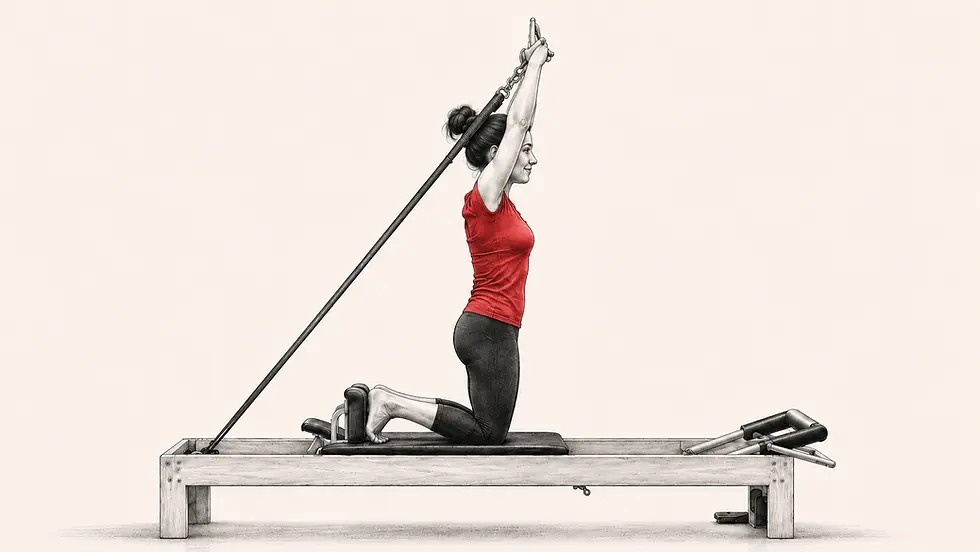
The Reformer is part of the studio, and many women use it happily, especially in the early months. The advantage of a full studio is that you are never limited to one position or one machine.
How I work
Sessions are private, one to one, and last 60 minutes. We begin with a conversation about how far along you are and how you feel that day. Then I choose the apparatus and positions, with breathing and posture first, and I ask you to tell me your doctor's or midwife's advice so I can coordinate with it. For most women one session a week is enough.
Frequently asked questions
Do I need to have done Pilates before?
Generally no, in an uncomplicated pregnancy and with your doctor or midwife's agreement. I adapt the session to your level.
Will I have to lie on my back?
No. Much of the work can be done on your side, sitting or standing, and I keep time on the back short and within what is comfortable for you.
Can I keep going until the end of the pregnancy?
As long as your doctor or midwife agrees and you feel comfortable. The apparatus change as the weeks go by, so you can keep moving.
Sources and further reading
To go deeper by stage, read Pilates in the first trimester and Pilates in late pregnancy. Women who live in Guadalmina will find the studio close by. If you would like to ask whether Pilates suits your pregnancy, message me on WhatsApp.
The author. Francisco Benítez, instructor at Authentic Pilates Studio, Marbella. Trained in 2002 and worked in a studio in Germany before opening his own studio in Spain in 2005.


Comments