Pilates for New Mothers: Strength for Carrying a Baby

Nobody trains you for carrying a baby for hours: one hip pushed out, shoulders rounded over a feeding baby, neck bent downward. By the third or fourth month, many mothers feel it in the upper back, the neck, the wrists and the lower back. This article is about that side of postnatal recovery, which gets less attention than the abdomen. It assumes you have already been cleared by your doctor or physiotherapist to exercise.
The postures of early motherhood
Feeding: shoulders rolled forward and the head ahead of the ribs.
Carrying on one hip: the pelvis shifts and one side of the back works harder than the other.
Leaning over the cot and the changing table: repeated forward bends.
Lifting car seats, prams and toddlers: heavy loads, often with tired muscles.
None of this is wrong. It is simply repetitive, and repetition is what the body complains about. The aim of the work is balance, so that your body has other options when the day asks for the same movement a hundred times.
Wrists, thumbs and the strange ache nobody mentions
Many new mothers develop pain at the base of the thumb or along the wrist from lifting and holding the baby with the thumb stretched out. It is common enough to have an informal name, and it deserves a doctor's attention if it persists. What I can do in the studio is reduce the load around it: improving how the shoulder and forearm share the effort, and changing how you hold weight so that the thumb stops doing all the work.
What we work on
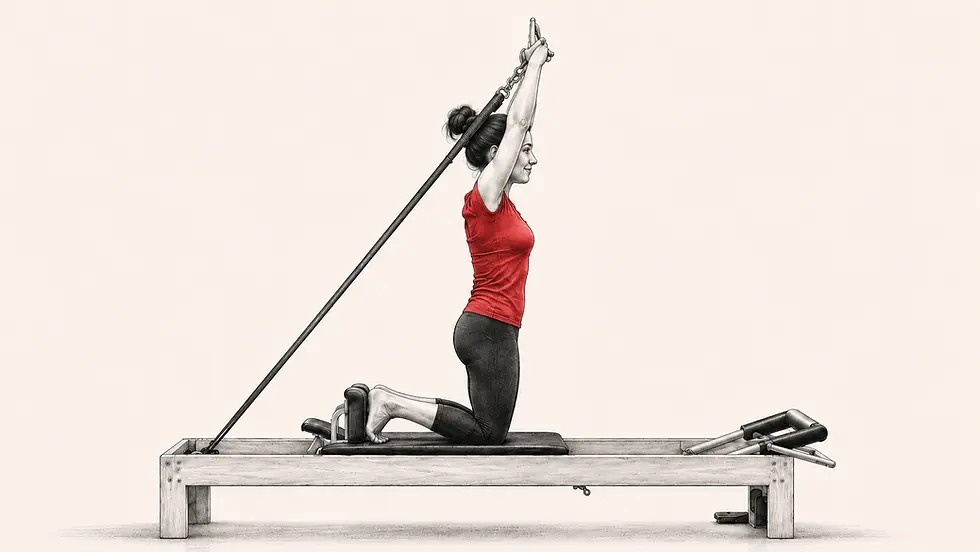
The upper back and shoulders come first. On the Reformer, the rowing exercises open the chest and strengthen the muscles between the shoulder blades, and on the Cadillac the arm springs let us work the shoulder girdle with support, so that the neck stops doing the job of the shoulders.
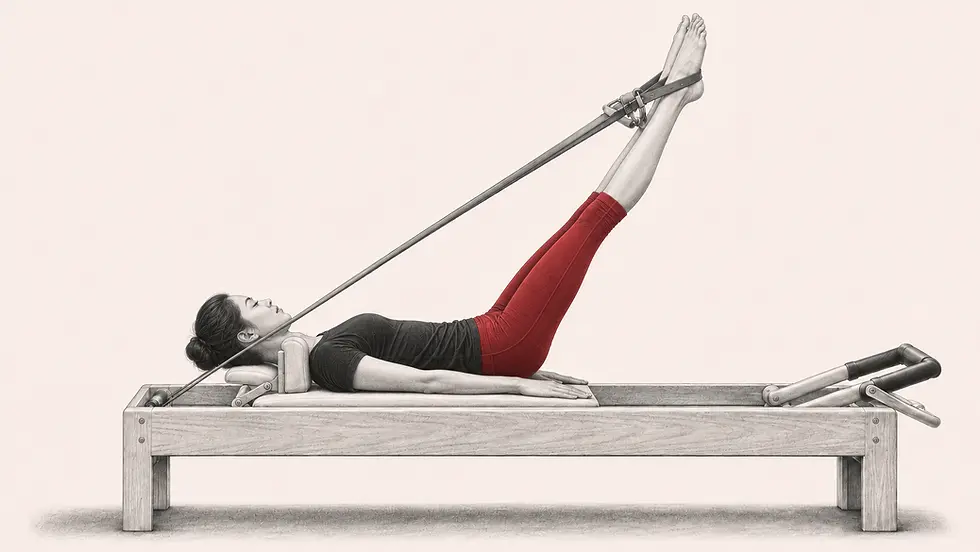
Then the hips and legs. The footwork on the Reformer is simple, and it is where I check whether you are standing on one side more than the other, a very common habit after months of carrying a baby on the same hip. A few quiet minutes there often tell me more than a long conversation.
Finally the trunk, but gently. Deep core control returns best when it is built after the posture, and I never ask you to do abdominal work that your doctor or physiotherapist has not approved.
Three small resets for the day
Change sides. Carry the baby on the other hip for part of the day, and alternate the arm you feed with when you can.
Raise the baby, not your shoulders. Support your arms with a cushion while feeding so that the weight sits on the cushion, and let your shoulders drop.
Breathe into the back of the ribs. A few slow breaths while the baby feeds takes seconds and loosens the neck more than stretching it.
If you use a baby carrier
A carrier that holds the baby high and close to your chest is generally easier on the back than one that lets the baby hang low and away from you. Adjust the straps so that the weight sits on your hips and the shoulders do not take it alone, and change position often. If a carrier gives you pain every time, it is worth having it checked by a physiotherapist or a babywearing consultant.
Strength without strain
Springs give resistance that can be changed in very small steps, which suits a body that is recovering and often tired. If you want to understand why I prefer springs to weights, I explained it in why classical Pilates uses springs instead of weights. The article on better posture and sedentary habits also applies to the long hours of feeding and holding.
Fitting it into a mother's week
Each private session lasts 60 minutes, and once a week is enough to make a difference. I would rather you came regularly for one session than tried to commit to two and gave up. If the afternoon is easier than the morning, or the other way round, tell me; the timetable should serve you.
Mothers who live in Puerto Banús will find a practical route in my guide on how to get to the studio from Puerto Banús and San Pedro, and the Puerto Banús Pilates page describes the area. If you would like to start gently, send me a message on WhatsApp and we will see how you are and what your week allows.
Looking after yourself on a tired day
Broken nights make everything feel heavier, and training at that point has to be realistic. On a tired day, a short walk and a few minutes of breathing are better than skipping everything or forcing a full session. If you are exhausted, tell me, and we will do something gentler. The most useful routine is the one you can keep up for months.
Frequently asked questions
When can I bring my baby to a session?
That is a conversation to have with me before you book, because it depends on the baby and on how the session is planned. Many mothers prefer to come alone for the hour so that they can focus.
Will I feel sore after the first session?
Mild muscle tiredness is normal. If you feel pain, or something feels wrong, tell me and your doctor.
Do I need to wait until my baby sleeps better?
No. The exercises can fit around a disrupted routine, and one hour a week is realistic for most mothers.
The author. Francisco Benítez, instructor at Authentic Pilates Studio, Marbella. Trained in 2002, teaching in his own studio since 2005, with private classical Pilates sessions in Guadalmina Alta.


Comments