Diastasis Recti: How Classical Pilates Approaches It

Updated: 2 days ago
Diastasis recti is a term many people meet for the first time after having a baby, usually from a friend, an internet forum or a physiotherapist. It sounds worrying. In most cases it is common, understandable and manageable, and knowing what it is makes it much less frightening. This article explains it in plain words and shows how I work with it in the studio.
What it is
The rectus abdominis, the muscle that gives the "six-pack" appearance, is made of two halves joined by a band of connective tissue called the linea alba. During pregnancy that band stretches to make room for the baby. Afterwards it may stay wider and softer than before, and the two halves sit further apart. When you lift your head or sit up, you may see or feel a ridge or a dome along the middle of the abdomen.
Many women have some separation in the first weeks after birth, and studies suggest that around a third still have it a year later. It is not an injury in the usual sense, and it does not hurt in itself, although it is often seen alongside back ache, a weak feeling in the core or pelvic floor symptoms.
How it is assessed
A physiotherapist usually checks it lying down, pressing the fingertips into the abdomen while you lift your head, and noting how many fingers fit between the two sides and how deep the tissue feels. Some use ultrasound. Both are more reliable than a check at home, and the width is only one piece of information.
The gap is not the whole story
You will hear different numbers about how many fingers wide a gap should be, and professionals do not all agree on the details. What seems to matter more is how the abdominal wall behaves: whether it can create tension across the middle and whether the belly stays flat, not domed, when you load it. That is why I encourage anyone with concerns to see a pelvic health physiotherapist, and why I treat the width as a guide, not a target.
How I approach it in the studio
Breath first. We begin by breathing into the sides and back of the ribs and learning to let the abdomen move without forcing it.
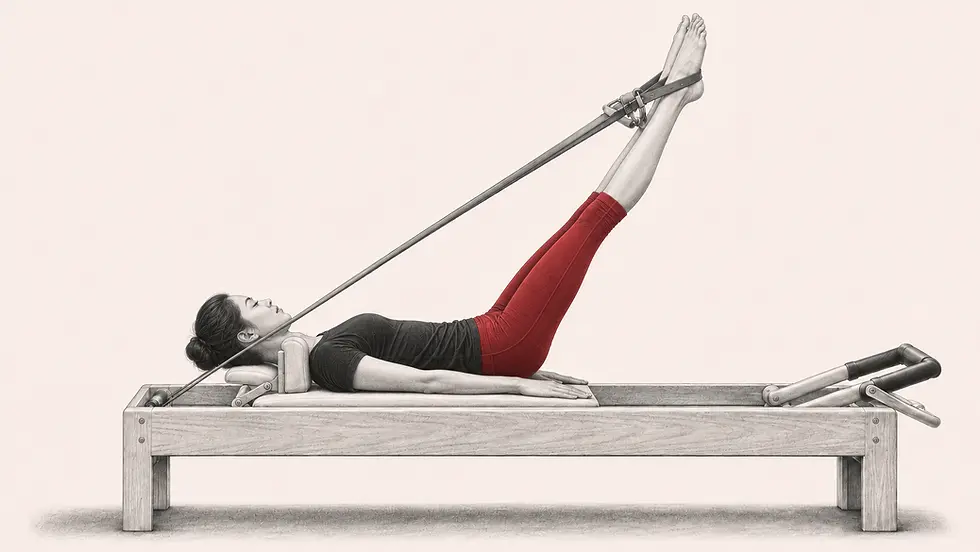
Supported positions. Lying on the Reformer with the springs holding the legs lets us work the trunk without the weight of the legs pulling on it.
No doming. If I see the middle of your abdomen rise during an exercise, we stop and choose something easier. The movement has to look and feel controlled.
Deep to superficial. We rebuild the deep layers of the abdominal wall before asking the surface muscles to do more.
A careful order. Some classical exercises begin with the spine curled forward, such as the Hundred and the Roll Up. I postpone those until you can control the pressure in your abdomen, then bring them back gradually.
Experts disagree on some cues
Some teachers ask you to draw the navel in towards the spine, and others warn that doing so can pull the two sides apart or push pressure downwards. I prefer a gentler cue: breathe into the sides of the ribs, let the abdomen soften on the inhale and let it gather towards the middle on the exhale, without sucking in. The research is limited, so I watch what your own abdomen does and adjust from there.
What I do not claim
I cannot promise to close a gap, and I do not treat diastasis. Healing varies from person to person, and a narrower gap is not always better than a functional one. What I can do is teach you to use your abdominal wall well and avoid the movements that make it worse, always alongside medical advice.
When to get it checked
Speak to your doctor or a physiotherapist if you see a bulge that comes and goes, if there is pain, if the dome appears at rest, or if you also have leaking or heaviness in the pelvis. In some cases where symptoms continue after months of well-guided exercise, a doctor may discuss other options.
Next steps
My article on Reformer Pilates during pregnancy covers the months before birth, and the powerhouse explains the deep core we rebuild. For the practical side, read which exercises to avoid and which to choose with diastasis recti. For the background of the studio, you can read about Marbella's original Reformer Pilates studio.
Frequently asked questions
Can I do Pilates with a diastasis?
Often yes, with a careful selection of exercises and after your doctor or physiotherapist has assessed you. The aim is to keep the abdomen flat under load and to build control.
How long does a diastasis take to improve?
It varies a lot. Some people notice better control within weeks, while the gap itself may change slowly or not at all. I focus on function more than on the width.
Should I see a physiotherapist first?
I would recommend it, especially if you have symptoms such as leaking, pain or a visible dome. I am glad to work alongside their advice.
Sources and further reading
To ask about your own situation, write to me on WhatsApp.
Written by Francisco Benítez, who trained in Pilates in 2002 and worked in a studio in Germany before opening Authentic Pilates Studio in Marbella in 2005. He teaches one-to-one classical Pilates in Guadalmina Alta.


Comments