Postnatal Pilates in Marbella: When and How to Restart

The weeks after a baby are strange for the body. Your abdomen no longer feels like your own, your back aches from feeding and lifting, and the pelvic floor, a group of muscles most of us never think about, suddenly asks for attention. If you live around Guadalmina, San Pedro de Alcántara or Nueva Andalucía and you are wondering when Pilates can be part of your recovery, this is how I think about it.
I am a Pilates teacher, not a doctor or a physiotherapist. What I bring is a long career of teaching: I trained in 2002, worked in a studio in Germany and opened my own in Spain in 2005. The lesson that keeps repeating itself is that recovery goes better when nobody is in a hurry.

Start with your doctor or midwife, not with me
Published guidance is not identical. Some physiotherapy guidance allows very gentle Pilates from around four weeks after a vaginal birth, provided the bleeding has stopped, any tear or wound has healed and there are no pelvic floor symptoms. Many health services ask you to wait until your check at six to eight weeks. After a caesarean, a complicated birth or a significant tear, the wait is usually longer.
None of those numbers is magic, and I would rather you follow the person who has examined you. Before you book, it helps to have three answers from them: has the bleeding stopped, has any tear or scar healed, and do you have any pelvic floor symptoms such as leaking or heaviness? If the answer to the last one is yes, see a pelvic health physiotherapist first. After that we can work alongside what they recommend.
What your body is still doing
Several things are still in motion at this stage, and a good postnatal programme respects all of them.
Softer ligaments. The ligaments loosen during pregnancy and can stay more flexible for months, so I avoid deep end-of-range stretching early on.
A stretched abdominal wall. After nine months of growing, the abdominal muscles need time to regain tension, and the deep layers come back before the surface ones.
A tired pelvic floor. The pelvic floor carries extra load throughout pregnancy, whatever kind of birth you had.
Broken sleep. Nothing slows recovery like missing sleep, which is why a session sometimes has to be gentler than we planned.
What the first sessions look like
Private sessions last 60 minutes, and the early ones are quieter than people expect. Before we move, we talk about the birth, any tear or scar, whether you are breastfeeding and what hurts. Then we begin with breathing, because the diaphragm, the deep abdominal muscles and the pelvic floor work as one system, and after pregnancy that system often needs to be reintroduced.
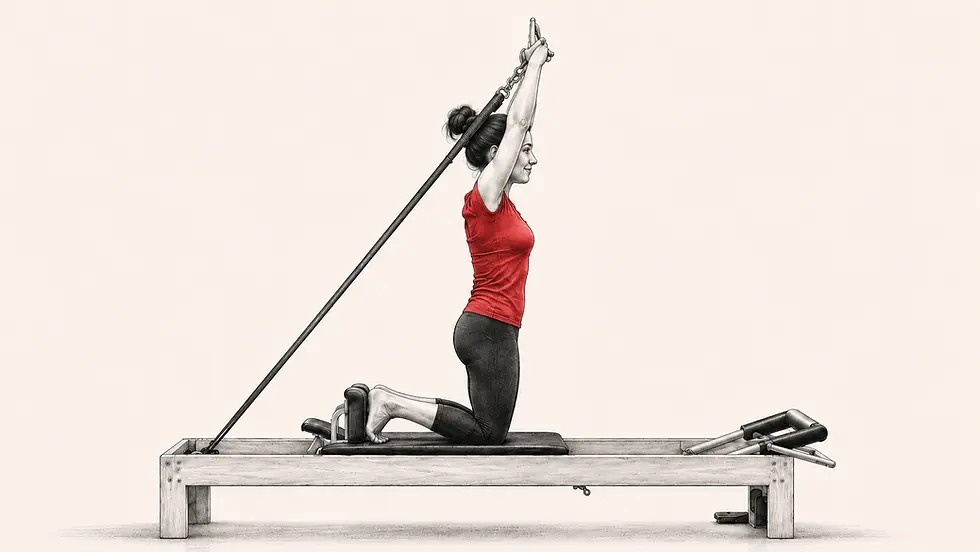
After that we move slowly, usually lying on the Reformer, where the springs support your legs and let us work the trunk without strain. The Reformer is one of sixteen pieces of apparatus in the studio, and the classical method gives me an order to follow, so the work grows only as your body shows it is ready.
A realistic progression
Stage one: breath and alignment. Learning to breathe into the ribs and find a neutral pelvis, lying down.
Stage two: supported work. Leg and arm exercises on the Reformer, with the springs doing part of the job.
Stage three: the trunk. Abdominal work returns as soon as you can keep the middle of the abdomen flat under load.
Stage four: the full repertoire. The classical exercises, in the classical order, adapted wherever your body asks.
Most mothers spend longer in the first two stages than they expect, and that is normal. Moving up too early is the most common way to lose the progress you have made.
What I leave out early on
Sit-ups, crunches and full planks, which push the abdomen outward.
Heavy lifting, and anything that makes you hold your breath.
Any movement that makes the belly bulge in the middle, or that you feel as pressure pushing down into the pelvis.
Pushing through tiredness.
What about running and jumping?
Expert guidance for returning to running after birth suggests not starting before about twelve weeks, and only once the pelvic floor and the strength of the legs and trunk have been checked. Pilates is a good way to prepare, because it builds the control that impact asks for, but it does not replace that check. If running is your goal, ask your physiotherapist to tell you when you are ready, and tell me, so that the sessions lead toward it.
Signs to pause
Stop and tell me, and your doctor or physiotherapist, if you notice:
Leaking of urine or stool.
A dragging or heavy feeling in the pelvis.
Pain at a scar or in the lower abdomen.
Increased bleeding.
A ridge or dome along the middle of the abdomen when you lift your head or sit up.
Why one-to-one suits this stage
Every week is different with a newborn. Sleep, feeding, how your back feels, how much energy you have: all of it changes from one session to the next, and a one-to-one hour can change with it. In a group class the instructor cannot watch your abdomen and your breathing the way this stage requires. I have written about the difference between private and group work, and for postnatal recovery it matters more than almost anywhere else.
Once a week is a very good rhythm for most mothers, and it fits around feeding and nap times better than a heavy schedule. Later, if you want to work harder, twice a week is excellent; how often to do private Pilates explains how I think about it. To understand the foundations we use, read about how breathing improves control and posture and about the powerhouse. If you exercised during pregnancy, you may like my piece on Reformer Pilates during pregnancy.
Sources and further reading
If you would like to talk through where you are in your recovery, send me a message on WhatsApp and we will find a calm way to begin. The studio is in the Guadalmina Alta area, and you can see how to find it on the Guadalmina Pilates page.
About the author. Francisco Benítez is a Pilates instructor who has worked in Pilates since 2002 and has run Authentic Pilates Studio in Marbella since 2005. He teaches private one-to-one sessions on classical Pilates apparatus in Guadalmina Alta.


Comments