Can Pilates Help You Lose Weight? What Research Says

It is one of the questions I am asked most often, and it deserves a straight answer rather than a sales line. Can Pilates help you lose weight? Possibly, a little, and mostly in indirect ways. Having taught since 2002, I have learned that the people who stay with Pilates are rarely the ones who were promised a number on the scale. Here is what the research says, and how I would think about it if you came to the studio in Guadalmina with that goal.

What the research shows
A 2021 meta-analysis published in Frontiers in Physiology pooled eleven randomised trials with nearly four hundred adults who were overweight or obese. On average, Pilates programmes lasting from two to six months were linked to a loss of about 2 kg of body weight, around one point of BMI and a few percentage points of body fat. Waist circumference and lean mass did not change significantly.
The authors themselves call the evidence limited. The trials were small, few were blinded, and the results varied a lot from one study to another. One of the main findings became less certain when a single trial was removed from the analysis. And the review could not say whether Pilates works better than other forms of exercise. In plain words: Pilates is not a fat-burning machine, and anyone who promises dramatic weight loss from it is selling something.
Weight and body composition are not the same thing
The scale cannot tell fat from muscle, water or bone. Someone who trains regularly can lose fat and gain muscle and see little change in weight, while their clothes fit differently and their posture changes. That is a good outcome, and it is the one Pilates is most likely to give you. If you only measure success by the scale, you may feel you have failed when your body is in fact improving.
What an hour of Pilates really is
Pilates is generally considered a light to moderate form of exercise. In one hour you will not burn as many calories as in the same time of brisk walking, cycling or running, and I would be doing you a disservice to pretend otherwise. What it offers instead is precision, strength and control, which is different from sweat.
Why it can still help
You will keep doing it. Pilates suits almost any level of fitness and is kind to the joints, and the best exercise for weight is usually the one you can repeat for years.
It builds muscle. The springs give you resistance work that is gradual and controlled, and muscle is the tissue that keeps the body working well as we age.
It improves how you move. When your back, hips and knees feel better, walking, swimming and golf become easier, and those are the activities that actually use more energy over the week.
It gives you confidence. For many people it is the first form of exercise that does not feel like a punishment.
What actually moves the scale
Weight changes mainly with the balance between what you eat and the energy you use across the whole week. Pilates is one part of that, and for most people daily walking, sleep and eating habits matter more. I am not a nutritionist and I will not give you a diet. If weight loss is your main goal, I would combine private Pilates with regular walking and, if you wish, advice from your doctor or a dietitian.
Questions to ask any studio that promises weight loss
What evidence do you have for that promise, and what happens if I do not lose weight?
Who adapts the programme to my body, and how many people are in the room?
Does the plan include anything beyond classes, such as walking or advice from a health professional?
Will I be asked to buy a long package before I know whether it suits me?
How I would plan it with you
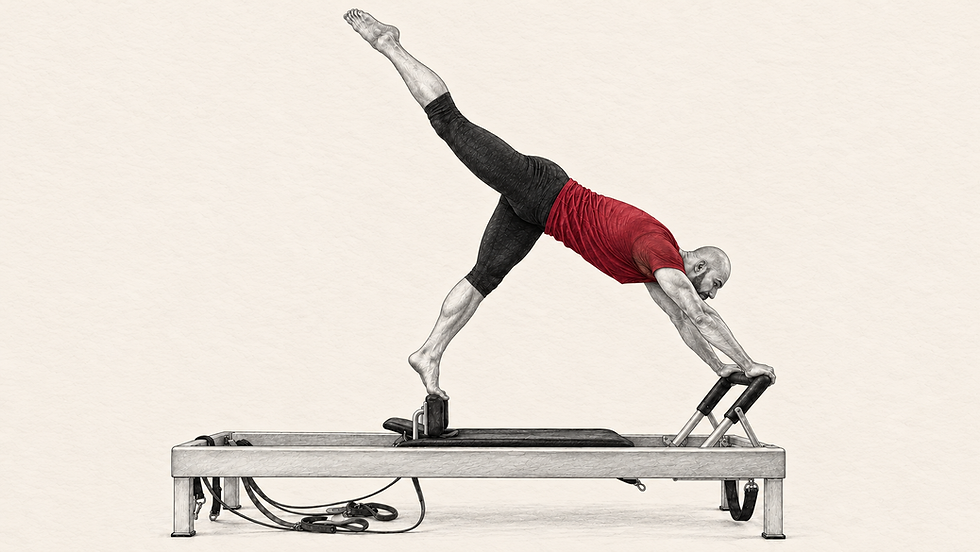
Each private session lasts 60 minutes, and once or twice a week is a sensible rhythm. The first goal is not calories but to move well enough that you want to come back. We start with the basics on the Reformer and progress along the classical order as your strength grows. I explain how I think about rhythm in how often to do private Pilates to see progress.
Honest expectations
In the first weeks: more energy, easier movement, a straighter posture.
After a few months: clothes that fit differently and noticeably better strength.
Not realistic: losing fat from one chosen area, or quick results without changing anything else.
If you would like a wider view of what to expect, read Is Reformer Pilates worth it? and why classical Pilates uses springs instead of weights. People come to the studio from San Pedro, Puerto Banús and Nueva Andalucía, and I have described Pilates in Guadalmina for residents of those areas.
Frequently asked questions
Is Pilates good for weight loss?
It can contribute a little, as the research shows, but it is not the most efficient form of exercise for burning calories. Its strengths are muscle, posture and consistency.
How many times a week should I do it?
Once or twice a week is a sensible rhythm, combined with daily walking.
Source
To talk about your goals before booking, write to me on WhatsApp.
About the author. Francisco Benítez is a Pilates instructor who has worked in Pilates since 2002 and has run Authentic Pilates Studio in Marbella since 2005. He teaches private one-to-one sessions on classical Pilates apparatus in Guadalmina Alta.


Comments