What Is Reformer Pilates? A Clear Introduction

Updated: 3 hours ago
Reformer Pilates is, at its core, a system of resistance exercises performed on a sliding carriage that moves along a frame, pulled back by a set of springs whose tension you can adjust, developed by Joseph Pilates as the central piece of equipment in a broader method he spent decades refining.
Breaking Down the Problem
What distinguishes it from most other forms of resistance training is the nature of the resistance itself. Where a weight machine or a dumbbell applies a constant force regardless of where you are in a movement, spring tension changes continuously through the range, generally offering less resistance at the start of a stretch and more as the spring extends, while also assisting the return rather than simply opposing it throughout. That changes what an exercise actually trains: instead of simply moving a load from point A to point B, you're learning to control a constantly shifting resistance with precision, which demands a level of coordination and core stability that fixed-weight training generally doesn't ask for in the same way.
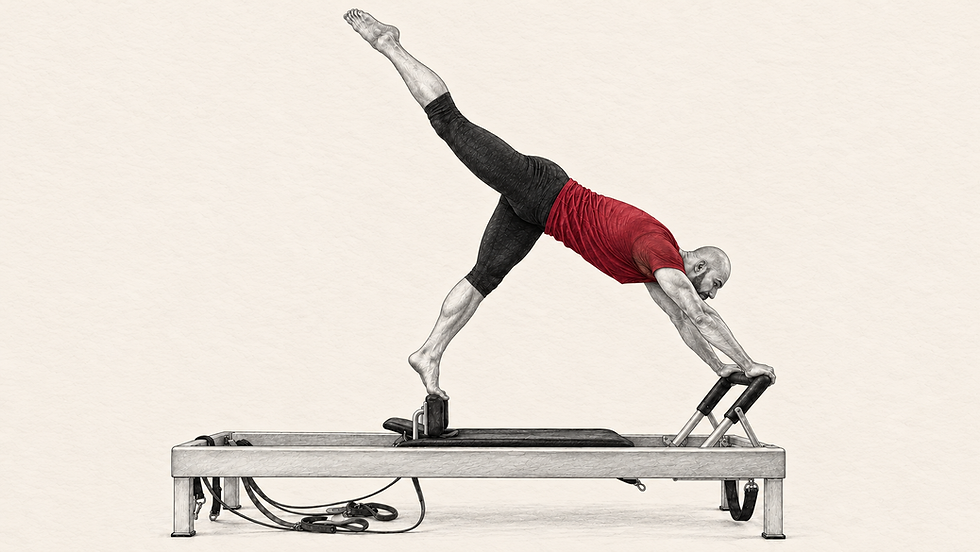
A typical exercise sequence moves between lying, sitting and kneeling positions on the carriage, using straps on the hands or feet, or direct contact through the foot bar, to load different muscle groups while the carriage itself does a meaningful share of supporting the spine. Footwork, usually one of the earliest exercises in any session, loads the legs while lying down with the back fully supported, which makes it an accessible starting point regardless of fitness background, while later exercises in the repertoire demand considerably more strength, coordination and balance as a session progresses.
Working With Reformer Pilates in Practice
What tends to surprise newcomers most is how much the slow, controlled pace of the movement actually demands, since removing speed and momentum from an exercise forces the targeted muscles to do the entire job themselves rather than letting momentum carry part of the load, which is a very different experience from most other resistance training most people have tried.
If you're curious what an hour on the reformer actually feels like before committing to anything, a first session is really the clearest way to find out, since the method tends to make much more sense once experienced than it does described.
To understand where an exercise like this sits within the classical method, you can look at the equipment we train on.
In short:
One-to-one sessions tailored to your body, not a generic program.
Taught on authentic classical apparatus at The Authentic Pilates Studio, Marbella.
Based in Guadalmina Alta, easy to reach from San Pedro and Puerto Banús.
Should this speak to where you are right now, you can schedule your first session.
Visit me at The Authentic Pilates Studio — Marbella.


Comments